Pickle and the Giant-Pickle-Eating-Machine-Eating Machine

One time, Pickle went to the grocery store. He went to the pickle aisle and picked out five jars of pickles. Then he went to the juice aisle and got some pickle juice. After he paid for his groceries at the checkout counter, he went outside. But Baby Pickle and his baby friends came along and stole all the jars of pickles right out of his trunk!

Pickle started to chase after the babies, but before he could catch up to them, they opened up one of the jars of pickles. They took out a pickle and put it into an enlarging function to make a giant pickle that got in Pickle’s way. He tried to go past but it blocked the whole intersection!

“Now what?” thought Pickle. He looked around and saw a vending machine. On the front it said, Giant Pickle-Eating Machine — $5.

“This is just what I need to eat up that giant pickle in my way,” said Pickle, and he got out a $5 bill and put it into the vending machine.

Out came a Giant Pickle-Eating Machine that started coming straight for Pickle. Suddenly Pickle realized that it was not a machine for eating giant pickles, it was a giant machine for eating Pickle!

Pickle said, “Oh no! This is not the kind of machine I wanted!” He drove away as fast as he could go, to get away from the Giant Pickle-Eating Machine that was trying to eat him. He drove all over the neighborhood, but no matter where he went, the Giant Pickle-Eating Machine kept following him.

Then he saw another vending machine that said, “Put in $5 and you will get the kind of machine you wanted.” So Pickle put in five dollars and out came a Giant-Pickle-Eating Machine. The Giant-Pickle-Eating Machine ate up the giant pickle but the Giant Pickle-Eating Machine was still chasing Pickle!

Pickle started to get tired. He needed a break, but he didn’t want the Giant Pickle-Eating Machine to catch up to him! He looked around for a place to hide, but then he saw another vending machine.

This vending machine said Giant-Pickle-Eating-Machine-Eating Machine on the front of it, and it had a sign that said, “Insert $5 here.”

Pickle got out another $5 bill and put it into the vending machine. Out came a Giant-Pickle-Eating-Machine-Eating Machine! It chased the Giant Pickle-Eating Machine and ate it all up. Whew! Now Pickle could stop running away. He was safe.

He went back to the intersection where the giant pickle had been. It was all eaten up by the Giant-Pickle-Eating Machine, but Pickle still had a problem. He could not go through the intersection because now there was a Giant-Pickle-Eating Machine in the way!

So Pickle looked around and found another vending machine. This one said, Giant-Pickle-Eating-Machine-Eating Machine — $5. So Pickle put a $5 bill into the vending machine and out came a Giant-Pickle-Eating-Machine-Eating Machine that ate up the Giant-Pickle-Eating Machine.

But then the Giant-Pickle-Eating-Machine-Eating Machine was in the way! Pickle still could not get through the intersection.

Then Pickle found a new vending machine and got a Giant-Pickle-Eating-Machine-Eating-Machine-Eating Machine. He got a version with wheels because that way, he could roll it out of the way after it ate the Giant-Pickle-Eating-Machine-Eating Machine. But as soon as the Giant-Pickle-Eating-Machine-Eating-Machine-Eating Machine on Wheels ate up the Giant-Pickle-Eating-Machine-Eating Machine, the babies turned the wheels into feet. It stuck out all its feet and sat down in the middle of the intersection, but first it kicked Pickle.

Pickle said, “Ouch!” and he still could not go through the intersection because the Giant-Pickle-Eating-Machine-Eating-Machine-Eating Machine on Feet was in the way and it refused to get up.

Pickle found another vending machine. All the vending machines had tunnels with conveyor belts inside that took the money straight to the babies. Pickle put $10 into the new vending machine and out came a Giant-Pickle-Eating-Machine-Eating-Machine-Eating-Machine-Toeing Machine.

It went straight over to the Giant-Pickle-Eating-Machine-Eating-Machine-Eating Machine on Feet and added toes to all the feet.

“Oh no!” said Pickle. “I thought this was a Giant-Pickle-Eating-Machine-Eating-Machine-Eating-Machine-Towing Machine that would tow the Giant-Pickle-Eating-Machine-Eating-Machine-Eating Machine but instead it put toes on all of the feet. It must be a Giant-Pickle-Eating-Machine-Eating-Machine-Eating-Machine-Toeing Machine. That’s not what I wanted at all!”

So Pickle found another vending machine and checked it very carefully to make sure it sold Giant-Pickle-Eating-Machine-Eating-Machine-Eating-Machine-Towing Machines instead of Giant-Pickle-Eating-Machine-Eating-Machine-Eating-Machine-Toeing Machines.

Pickle put $15 into the new vending machine and out came a Giant-Pickle-Eating-Machine-Eating-Machine-Eating-Machine-Towing Machine but when it tried to tow the Giant-Pickle-Eating-Machine-Eating-Machine-Eating Machine on Feet, it couldn’t get it to move because of how it was sitting down with its feet stuck out.

So Pickle got a lot of sticks and a lot of feathers and a lot of glue. He used the glue to stick the feathers onto the ends of the sticks to make ticklers. Pickle used his ticklers to tickle all the feet of the Giant-Pickle-Eating-Machine-Eating-Machine-Eating Machine.

It jumped up and down saying, “Ee-hee-hee-hee-hee!” and then the Giant-Pickle-Eating-Machine-Eating-Machine-Eating-Machine-Towing Machine was able to tow it away.

Finally, Pickle could go through the intersection. But by then, the babies had already eaten up all of his jars of pickles.

Tickle, Tickle, Stop!

Kidpower is my blogging nemesis. I’ve been wanting to write about it for a very long time, but whenever I try, I get tangled up in perfectionism and end up with a hyperbolic landscape of half-finished blog posts. But every parent needs to know about Kidpower because it’s so good! So today I’m just going to write about Kidpower for half-an-hour and publish whatever I end up with at the end of it. [It ended up being more like three hours, but still — I did it!]

Earlier this week I embarked on a series of formal Kidpower lessons with the kids. I already incorporate Kidpower principles in my everyday language and parenting interactions, but I like to do more intentional teaching and practice sessions every so often.

To prepare for the lessons, I went back through all the notes I have in my giant Kidpower Book for Caring Adults. Back when Luke was five, he went through a phase of requesting Kidpower lessons multiple times per day, so over the course of a few months, we had made our way through all the parts of the book that are relevant for little kids. (If you are ready to become an expert Kidpower parent, I highly recommend this textbook of a book. Besides being really great for gaining a deep working understanding of Kidpower principles and methods, it has really nice step-by-step instructions for doing hands-on lessons with your kids.)

As I went through the book, I made a checklist for myself of all the lessons I want to do with my current set of kids (Luke age 7, Nathan age 4, Daniel age 1 1/2, and two foster kids ages 7 and 8). I picked Stop Power, Mouth Closed Power and Hands Down Power to start with because I knew they’d be an engaging place to start, plus they are highly relevant for the pushing-and-shoving kinds of conflicts that the kids have been getting into. But I do want to go back to the beginning lessons soon, so we can lay down that foundation of being calm, confident and aware.

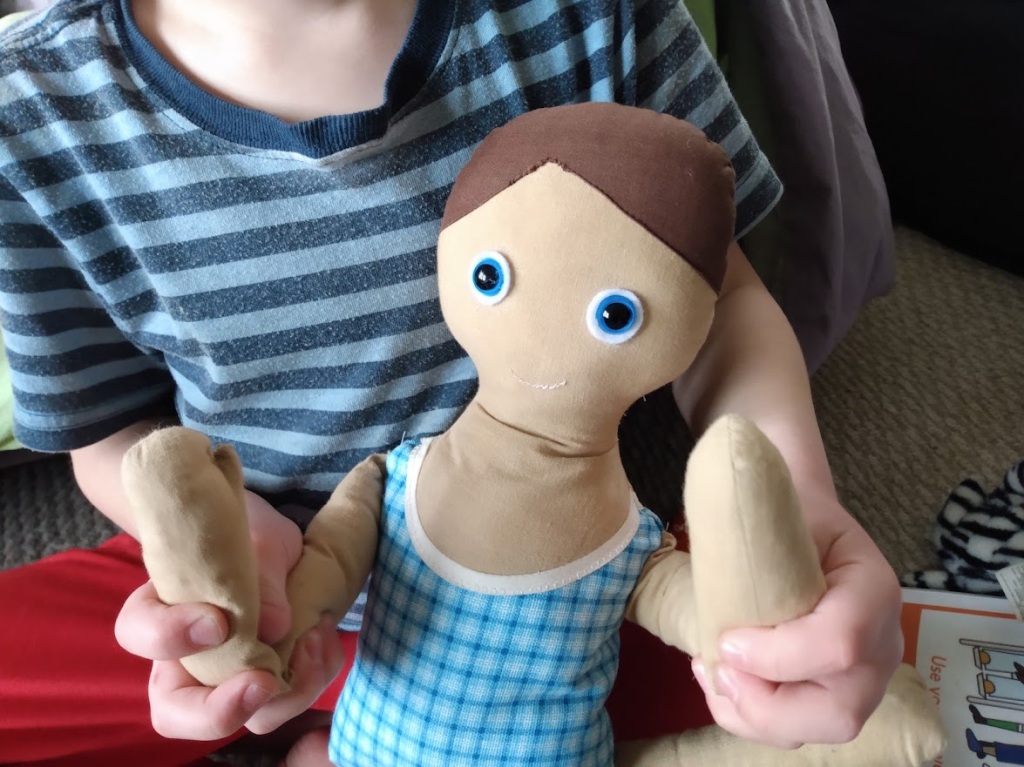
For the first lesson, I got out a bunch of stuffed animals and did some puppet shows on the topic of using Mouth Closed Power and Hands Down Power to stop problems from getting bigger. I gave the kids a chance to tell their own puppet stories and then we gathered in the kitchen in a circle to practice using Stop Power and Hands Down Power with our bodies.

Toddler Stop Power

Even toddlers can learn to use Stop Power, which involves putting your hands up in front of you and say “Stop” in a firm voice, to make it clear to someone that you want them to stop bothering you. I demonstrated this to Daniel a few times and now we have a game called Tickle-Tickle-Stop.

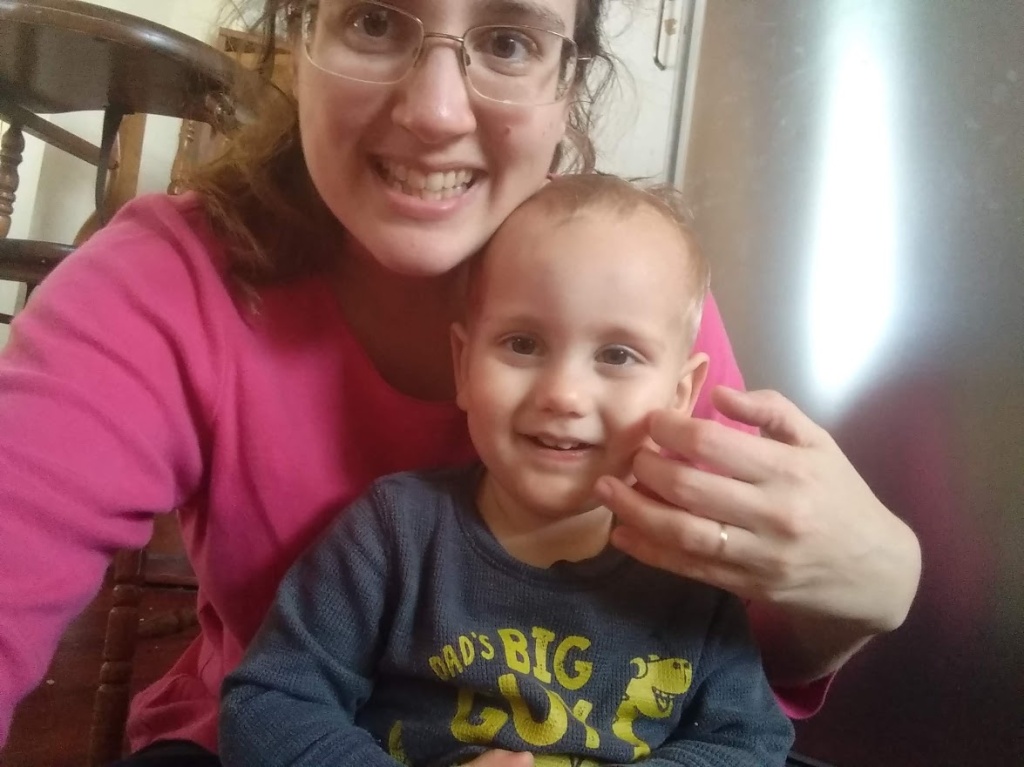
One-year-old Daniel is sitting on my lap while I tickle his cheek. We're both looking at the camera because a selfie was the only way I could get a good picture.

Daniel starts the game by wiggling his fingers and saying “Dee-doo, dee-doo!” I wiggle my fingers back at him, saying “Tickle, tickle!” as I slowly move toward his neck for a tickle. As soon as he puts his hands up and says, “Dop!” I immediately pull my hands back, clap them down at my sides, and say “Okay, I’ll stop!” After he’s done giggling, he’ll prompt me to start tickling again with another “dee-doo dee-doo.”

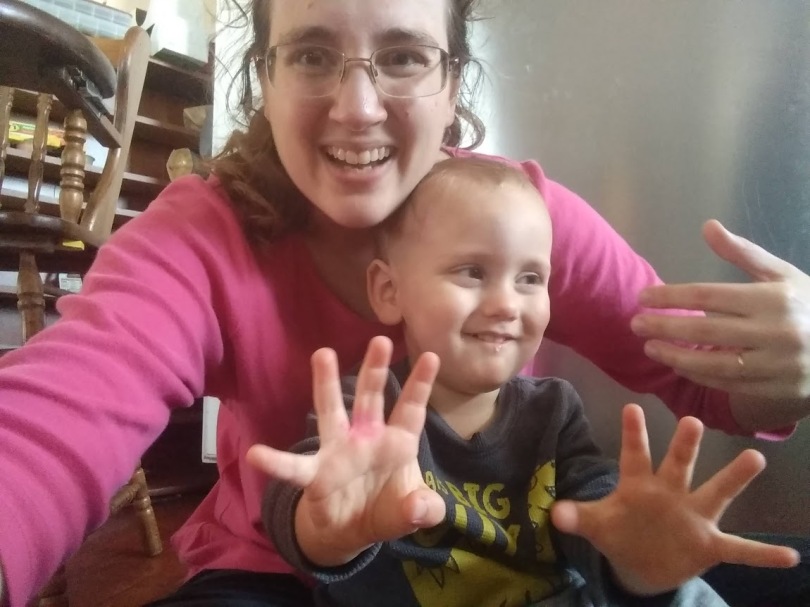
Daniel and I are putting our hands forward to make our stop signs while giggling together.

Now that Daniel knows how to do Stop Power, I’ve been trying to get him to use it in context. His go-to when one of the other kids gets in his space is to push or hit them away. When I see this, I prompt him to use Stop Power instead. So far it hasn’t quite clicked but he’ll get there. In the meantime, Tickle-Tickle-Stop is a big favorite. Luke was playing it with him last night and I want to get the other kids involved so Daniel learns that he can use Stop Power with everybody, not just me.

Safety Rules for Touch and Play

Yesterday I did another lesson with the big kids. This time I was prompted by some trouble one of them got into at school, playing a game with friends at lunch that involved getting on top of the tables and pretending to shoot each other. 😬

They’ve heard me go over the rules for what makes a good game a zillion times, but I figured this was a good opportunity for some in-depth coverage of the subject. Plus I realized that we had not done any practice on what to do if someone is encouraging you to join in on a game that does not follow the safety rules.

Here’s one of my favorite things about Kidpower: it teaches practical skills that are useful for everyday life. But at the same time, the skills are also designed to protect kids if they ever find themselves in higher-stakes situations — the scary stuff like sexual abuse, violence or abduction.

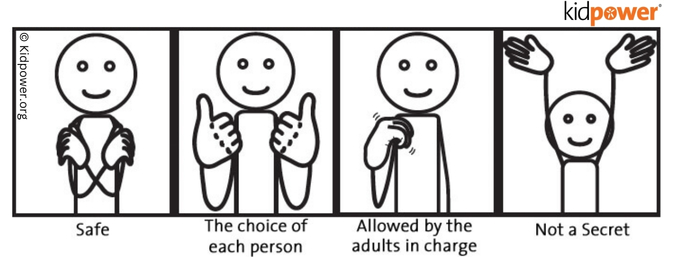
A good example of this are the safety rules for touch. Kidpower teaches that touch and games must be:

  1. Safe
  2. The choice of both people
  3. Allowed by the grown-ups in charge
  4. Not a secret so everybody can know
Four cartoons showing the safety signals for each rule. To show "safe," you give yourself a hug. To show "the choice of each person," you do a double thumbs-up. To show "allowed by the adults in charge," you make a fist and nod it up and down like a grown-up saying yes. To show, "not a secret," you open your arms and spread your hands in the air.

That covers so much! For our lesson, we brainstormed examples of games that would not be safe (e.g. punching), games that might not be the choice of both people (gentle punching), games that would not be allowed by the grown-ups in charge even if they are the choice of both people (gentle punching at school) and games that would be a secret (finding a hiding spot to punch each other). 

We also talked about how the grown-ups in charge are different depending on where you are. We discussed the different places we go and who’s in charge at those different places: teachers at school, volunteers at church, and ride operators at the amusement park.

Then I acted out some little puppet shows where Turtle tries to get Sammy to play a game and Sammy uses Think First Power to realize that it breaks one of the safety rules. 

Drawing from the first three of the Five Levels of Intrusion, I showed how Sammy can remind Turtle about the safety rules in case he didn’t notice that his idea was not a good game. “I don’t want to play that game because it’s not allowed by the grown-ups in charge.” 

I showed how if Turtle doesn’t listen the first time, Sammy can get up and make a fence with his hands to show that he means it: “No, I’m not going to play that game.”

And I showed how if Turtle tries to make Sammy feel bad by saying, “You’re not my friend if you don’t play this game,” Sammy can say, “I am your friend, and I’m not going to play that game. We can play a different game instead.”

Luke was fiddling with a little airplane and while I was acting out the puppet shows, he would zip the airplane through the scene with little snippets of relevant commentary. It was cute and showed me that he still has a foundation of background knowledge from the previous discussions and lessons we’ve done.

After the puppet shows we did some practice with our bodies, specifically with making a fence with our hands while saying no to an unsafe game. The kids had a lot of fun coming up with ridiculous propositions to suggest to each other. “Let’s play on top of the kitchen cabinets!” “No! That’s not safe and we would get in trouble with the grown-ups in charge!”

This is definitely just a start but I’m excited to do more. I like the format of doing a short puppet show at the table followed by a short practice session in the kitchen. I’m happy that the kids are interested and engaged. I’m glad that we can do it with Daniel around and he doesn’t get in our way too much. (He likes to sit on the table and grab at the puppets but it hasn’t been too much of a distraction.)

Kidpower Books

Last night I was on Amazon looking for another copy of the Kidpower Safety Comics. We have an old copy lying around somewhere but the new version is in color and I think it has more content. We used to have the new version too but I sent it along with our last set of foster kids when they moved out. So today I ordered two more copies — one for us to keep and one for our current foster kids.

But now I am overwhelmed by choices because I discovered two more Kidpower resources that I didn’t know about before. (I’m not a Kidpower affiliate, I promise — just a big fan!)

The Kidpower 6-Part Teaching Books Series looks like it is perfect for what I’m trying to do with the kids. I got the first one on Kindle and I love how it has lesson plans with step-by-step instructions for both group and individual practice. The only drawback of the Kindle version is that I can’t read the lesson plans on my Kindle screen because the text is too small and blurry. (It’s one of those converted-to-Kindle books that’s not actually reformatted for the Kindle so you can’t change the text size.) 

I did have a good time reading the story pages to the kids the other night. (It has stories we’re familiar with from the Safety Comics plus other stories in the same style.) I like the simplicity of reading the comics on the Kindle because there’s just one image per page and we can talk about the story before we move on to the next page. With the traditional Safety Comics, you have eight images on the double-page in front of you and there’s more pressure to move on to the next scene because the kids are already looking ahead.

From what I’ve seen so far, I really like the content of the Teaching Books series. The problem is it’ll cost $120 if I want a hard copy of each book to put on the dining room table and use during a lesson.

The alternative I found is the Kidpower Confident Kids Safety Lessons, which has 15 group lessons in one book. I’m just not sure how much it has in the way of individual practice. I do have dreams of running people-safety lessons for my homeschool co-op so I think it would be a good fit for what I’m envisioning there, but for my own kids at home I want to go more one-on-one.

I told Claudiu I was having a hard time deciding which new Kidpower books to buy and his response was to stage-whisper “All of them! One at a time — or is there a discount to buy the whole set?”

There’s no discount that I know of, so I think I will go ahead and order just the first teaching book for now. Once we finish all of those lessons, I will get the next one! And I will save Confident Kids for when I’m actually ready to turn my co-op dreams into a reality. Maybe this summer!

There’s Milk and Cereal On the Table

I came downstairs this morning to change Daniel’s diaper and found a box of cereal, a gallon of milk, and a mostly-eaten bowl of cereal on the table. The kids were all in the playroom jumping on the bean bag couch.

As I took Daniel over to the changing table, I called out an observation: “I see milk and cereal on the table.” I heard Carter accuse Logan*, who denied the accusation. Carter is not a very reliable witness, but I was still pretty sure that Logan was the culprit. He’s the most likely kid to have served himself cereal for breakfast plus I had seen him leave out the milk and cereal several times yesterday.

As I continued with the diaper change, I said, “I don’t want the milk to go bad. I don’t want Daniel to dump out the cereal.” The kids continued to jump and play in the playroom with no indication that they’d heard me.

After I finished the diaper change, I went into the playroom and quietly looked at Logan until I caught his eye. Then in a firm voice, I said, “There’s milk and cereal on the table.”

He immediately walked over to clean it up, commenting, “I didn’t do it.” I followed him as he put everything away and said, “Thank you for fixing the problem. You are a problem buster!”

There were a few drops of milk and cereal on the table so I got a wipe and said, “I’ll wipe the table. We are a good team.” He agreed and went back to play.

I love that I was able to have Logan take responsibility (in actions if not in words) for a problem without any yelling, blaming, or arguing. Just neutral observations, physical presence and teamwork. This is how I want to parent so I’m always happy when I do it!

*Names of foster kids have been changed to protect their privacy.

Flip It!

We like to invent new Tiny Polka Dot games around here. The latest one is Flip It, which is a good game to play with a preschooler who is learning about more and less.

First you’ll need to make an inequality sign. I cut mine out of corrugated cardboard and drew the < symbol with a permanent marker. I made a whole set of these back in December and they’re still going strong, despite getting chewed on regularly by Daniel!

If you cut it the same size as the Tiny Polka Dot cards, you can store it with them in the box.

Deck

For the first game, play with 0–5 from Teal, Blue, Green and Red. Later games can use 0–10 from any two decks of your choice.

Setup

Pick two cards from the deck and lay them out face up. If both cards are the same, draw again. Otherwise, place the inequality sign so that the expression is true.

Play

Players take turns drawing a card and placing it on top of one of the existing cards. The goal is to make it so that you have to flip the inequality sign to make a true expression.

E.g. if you’re starting out with 2 < 4 and you draw a 5, you’ll want to put the 5 on top of the 2 so you can flip the < around and make 5 > 4.

Play continues until all cards have been used or the players get bored.

I’ve mostly been playing this game with three-year-old Nathan, who has a surprisingly-long attention span for it. I had to walk him through the first few games:

Nathan: Ten and nine.
Me: Which one has more?
Nathan: Ten!
Me: And which one has less?
Nathan: Nine.
Me: So you have to flip it.
Nathan: Ok.
Me: There, nine is less than ten.

After a little while, he started to get the hang of it.

Nathan: Nine! I found a nine. A nine. If I put it here, I don’t have to flip it. If I put it here, I have to flip it! Cause nine has more.
Me: That’s right! Nine has more, so eight is less than nine.

Nathan: Seven. I will put it here, Oh! I will flip it. Five is less than seven.

Nathan: Where should I put this? I could put it here and I would have to flip it. If I put it here . . . Oh, I have to not flip it. Two is less than nine.

Luke joined in once or twice:

Luke: I’ll go first. A zero. I guess I’ll put it here, and flip it! What’s this game for?
Me: There’s not really a winner or a loser. You just get to decide where to put it.
Nathan: I’ll put it here but I can’t flip it. If I put it here, I can’t flip it.
Luke: You just can’t flip it.

Nathan: Four!
Luke: Put it on this side.
Nathan: Here? Here. I have to flip it. Four has more.
Luke: Three. Umm. . . no matter where I put it, I don’t get to flip it! I’ll put it here.
Nathan: Eight! Eight.
Luke: Left side!
Nathan: I’ll put it here. It looks like I win.

Explosive Child Review

I just finished reading The Explosive Child by Ross W. Greene for the second time. I picked the book back up because Luke has been experiencing some out-of-control bad feelings in the past couple of weeks and I was hoping to find some relevant advice. When I first read the book, I didn’t have any parenting experience past the toddler years, so it was all theoretical.

I like the practical suggestions for discussing the patterns of difficulty with your child in a way that doesn’t trigger their defensiveness or frustration, and I like the emphasis on teamwork. It outlines a plan for brainstorming potential solutions together.

I don’t agree with the author’s claim that all behavior problems boil down to a skill deficit in the child, but I do think this can be the main problem some of the time. Especially when all attempts to provide external motivation via rewards and punishment have failed, it’s worth considering whether there are some basic skills (planning, time management, impulse control, etc.) that the child needs to learn.

I also like the book’s suggestion to list out all the problem areas and then prioritize them, picking just a handful of situations to focus on while leaving the rest on the back burner for a while. It’s helpful for avoiding that feeling of being overwhelmed and makes it easier for everyone to focus on building up new habits in the most important areas.

One thing I didn’t like was how the author dismisses concerns by re-defining the terms. For instance, there is a Q&A section toward the book with questions like “What if it’s not working?” and answers like “You can consider it to be working if these various parts of the process are happening.” Not super reassuring!

I am taking the shotgun approach to solving our current problems, and am currently reading and rereading a number of different parenting resources simultaneously. So it’ll probably be hard to tell which strategies end up working!

So far today has been going a lot better for Luke, which is encouraging. Maybe these difficulties will clear up as quickly and mysteriously as they arrived!

Sibling Conflict With Toys

Here’s another recent Facebook comment I made, in response to a mom expressing concern that her toddler only wanted to play with the baby’s toys, leaving the baby stuck with the toddler’s toys.

I wouldn’t worry to much about them playing with each other’s toys.

What I would focus on teaching your son to wait for his turn with a toy if the baby is playing, rather than grabbing it away from her or interfering with her play. It’s never to soon to start teaching “peaceful playing together” skills.

If she takes something that he’s busy with, I would allow him to take it back (gently) as long as he gives her a replacement toy.

He can also learn to offer her a trade, if she’s playing with something and he wants a turn.

I have a three-and-a-half-year-old who plays very sweetly with his seven-month-old brother — he’ll drive a car around for the baby to watch/chase, or he’ll bounce a soft toy off the wall to get some really big giggles out of the baby.

I’ve been trying to teach him other games he can play like peekaboo, since he’s started to get rough sometimes (in a playful way, but his little brother doesn’t always like it).

Younger kids like your son are still in the solo-play stage, but any positive playing together that you see is something to encourage in my book 🙂

We don’t enforce “sharing” in the sense of making our kids give up their turn before they’re ready to be done. I say a lot of “When he’s done, you can have a turn for as long as you want. Right now you need to wait until he’s done with his turn.”

Toilet Learning

Someone on a Montessori Facebook group was asking for advice on handling a kid who is having pee accidents and resistant to prompting. I shared the following thoughts:

When my second son said he didn’t have to pee, I would say, “It’s still time for a toilet visit. Let’s sit on the toilet and see if any pee is ready to come out. Maybe it will just be a little bit.” I would slowly count to twenty and usually my instincts were right and he would end up peeing.

It’s definitely a tough balance to strike between when to insist and when to step back and give him the opportunity to go on his own.

With a situation like your grandson, I would probably try a few weeks of being very insistent (in a matter-of-factly way): it’s time for a toilet visit. And I would try to make it easier on him by timing the prompts for when he’s not in the middle of something (or allow him a few minutes wiggle room to finish it).

My goal there would be to make toilet visits the norm, rather than an optional thing that gets negotiated every time. Once that’s established I would look to gradually give him more room to be the one taking initiative.

But it’s hard! It’s not a linear experience and so much depends on the particular quirks of the kid!

I always have to remind myself that potty training is not linear. It’s not like crawling or walking where as soon as they figure it out, that’s all they want to do. With a milestone like choosing to go pee on their own, there can be a considerable gap between doing it for the first time and doing it all the time.

Fortunately, they do get there eventually!

Baby Pickle and the Spaghetti Code

Click here to read all the Pickle stories in chronological order.

One time Pickle wanted to make some spaghetti for dinner. He looked all over the kitchen, but he couldn’t find any boxes of spaghetti. He decided to make a spaghetti machine so that he could make his own spaghetti.

He collected all the ingredients that he needed: flour, eggs, salt and oil. Then he got a holding function. It had a big bowl to hold all the ingredients.

Pickle put his ingredients into the holding function and added a mixing function to mix them all together. Then he put a squeezing function that would take the pasta dough and squeeze it out into a long piece of spaghetti.

After that, he was going to add a cutting function to cut the long piece of spaghetti into shorter pieces, but first he had to go to the bathroom.

While Pickle was using the bathroom, Baby Pickle came along. He looked at all the pieces of Pickle’s machine to see what it would do. He saw how it would make one long piece of spaghetti come out of the squeezing function.

Then Baby Pickle had an idea. He took the squeezing function off the machine and put it through a ×100 function so that he had one hundred squeezing functions. Then he put them all onto Pickle’s machine, so that the dough would get squeezed into one hundred pieces instead of just one piece.

As soon as Baby Pickle heard Pickle coming out of the bathroom, he raced away and hid under the bed in the playroom. When Pickle got back to his spaghetti machine, it was bristling with squeezing functions. “Oh, no!” cried Pickle. “How am I going to cut all the spaghetti that comes out of all these different squeezing functions? I only have one cutting function!”

Then he saw the ×100 function where Baby Pickle had dropped it. Pickle put the cutting function into the ×100 function and went around to each of the squeezing functions to put a cutting function on the end of each one. Now the spaghetti would get squeezed out through one hundred squeezing functions and cut by one hundred cutting functions. But how would he collect all those pieces of spaghetti into a bowl?

Pickle built a conveyor belt to carry the bowl around to all the different cutting functions so it could catch each piece of spaghetti as it came out. Then he turned on the spaghetti machine to see what would happen.

The holding function that held all of the ingredients put them into the mixing function, which mixed them all up. Then the mixing function put the mixed-up pasta dough into all the squeezing functions. Each squeezing function squeezed out the dough into a long piece of spaghetti, and the cutting function at the end of each squeezing function cut each piece in half. Then all the pieces of spaghetti fell down. A few of them fell into the bowl as it whizzed by on the conveyor belt, but most of the spaghetti just fell on the conveyor belt.

The bowl got to the end of the conveyor belt and Pickle picked it up. It had four pieces of spaghetti inside. He got a fork and tried to eat them, but they were so long that it was hard to pick them up with the fork.

“This machine needs some work,” said Pickle. He looked at one of the cutting functions and saw that it was set to one. He decided to change the setting to three so it would cut the spaghetti into quarters instead of halves. This would make the pieces a lot shorter and easier to eat.

Pickle went around from one cutting function to the next, changing the setting on each one. He kept count of how many he had changed: 10, 20, 30 . . . . Pickle got tired and took a break after he had changed 60 cutting functions. He was more than half-way done! 70, 80, 90 . . . .

When Pickle got to 97, he couldn’t find any more cutting functions that were still set to one. All the functions he looked at were already set to three. “Did I count wrong or did I skip some cutting functions?” he wondered.

Pickle searched and searched but he couldn’t find any more cutting functions to change. He decided that it would be okay if a few of the spaghetti pieces came out too long. Most of the spaghetti would be short and that was good enough.

Next Pickle had to figure out the bowl problem. He put the bowl into the ×100 function and out came one hundred bowls. He arranged all the bowls on the conveyor belts, with one bowl under each cutting function. Now all the spaghetti would fall into a bowl.

At the end of the conveyor belt, he put a pouring function. The bowls would feed into it and the pouring function would pour each bowl out into a bigger bowl that Pickle put at the bottom.

Pickle put more flour, eggs, salt and oil into the holding function and ran his spaghetti machine again. The mixing function mixed up all the ingredients and the squeezing functions squeezed out long pieces of spaghetti. This time the cutting functions cut each piece three times to make four short pieces of spaghetti. The spaghetti pieces fell into the bowls that were waiting on the conveyor belts. Then the conveyor belts brought all the bowls into the pouring function, and the pouring function poured all the spaghetti into one big bowl for Pickle to eat.

And that’s the story of Pickle and the Spaghetti Machine.

Interrupted By Math

A few weeks ago, I was sitting at my computer trying to finish up my work for the week. Luke was next to me working on his math pages for the day, so Nathan brought over the Magna Doodle and declared that he wanted to do some math too.

We came up with a simple game that involved rolling dice and writing an addition problem on the doodle board. I was impressed that Nathan already knew how to draw a plus sign, since that’s not something I’ve ever taught him! I showed him how to check his answer by drawing dots and counting them up. Then I turned back to my work, happy that both kids were productively occupied.

Luke was inspired by Nathan’s activity to write some equations of his own. He showed me his paper, where he’d written
0 × 0 = 0
0 + 0 = 0
0 _ 0 = 0
0 _ 0 = 0

Luke: Fill in the other signs. It has times and plus.
Me: So I’ll put divided-by and minus. But also . . . [I crossed out the equals sign in 0 ÷ 0 = 0]
Luke: Hey! [He started to erase his defaced equals sign.]
Me: You can’ t do zero divided by zero because you can’t divide anything by zero.
Luke: You can’t?
Me: No.
Luke: Let’s figure it out.

He turned his paper over and wrote 2 ÷ 0 = □. We looked at it for a little while.

Luke: Let’s figure it out. Can we figure it out?
Me: Okay.
Luke: . . . 
Me: . . .
Luke: If we had Numberblocks Two and Zero, we could put them together with the divided-by sign.
Me: Mmm.

I let him struggle a little more before stepping in with some leading questions.

Me: If you have two cookies and you divide them up equally between zero people, how many cookies does each person get?
Luke: But there are no people!
Me: Ah. If you have two cookies and you want to put them into bags and each bag can hold zero cookies, how many bags do you need?
Luke: ???
Me: You can’t do it! You just can’t divide by zero because it doesn’t make sense.

Feeling good about my use of quotative division, I turned back to my computer and restarted my work timer.

Before long, Nathan piped up with a question stemming from his recent interest in cubes.

Nathan: Why is One a cube?
Me: Because she’s a Numberblock and they’re made of cubes and she only has one.
Nathan: Why is Twenty-Seven a cube?
Me: Because she can make her blocks into three-by-three-by-three.
Nathan: Is Twelve a cube?
Me: No, Twelve is a cuboid because she can be two-by-two-by-three.
Nathan: Can Sixty-Five make a cube?
Me: Hmm, let’s figure it out.
Luke: No, of course not! Because Sixty-Four is a cube.
Me: Luke is a party-pooper. Let’s figure it out, Nathan.

After we discussed what a party-pooper is and how Luke was being one by giving us the answer instead of letting us have the fun of figuring it out together, I got out the base ten set so we could try making a cube out of 65 unit cubes.

Pretty soon it was clear that Nathan had lost interest in his cube question, so I let him play in his own way and turned back to my work. Meanwhile Luke had grabbed some ten rods.

Luke: Can One Hundred make a rocket? I know Fifty-Five can make a rocket.
Me: Why don’t you try it and see while I go through these emails?

Luke soon realized that the rocket he had in mind was hard to build with the rods since they don’t stick together.

Luke: I want to do it with Numberblocks.
Me: Sure, we can do it with Numberblocks.
Luke: I know we can do it with Numberblocks because we have 10 tens.

I went downstairs to the dining room to get out the Numberblocks set and Luke got to work.

At this point I decided that my work would have to wait until after the math cooled down. I gave up on my fruitless multitasking and started taking notes on all the wonderful questions and conversations we were having. Pretty soon, Nathan brought me the thousand cube.

Nathan: What’s this number?
Me: That’s One Thousand.
Nathan: One Thousand can be a cube that’s one-by-one-by-one-by-one-by-one . . . one, two, three, four, . . . One thousand can be a cube that’s ten-by-ten-by-ten!
Me: That’s right!

A little while later, Nathan showed me the thousand cube with a hundred square stacked on top.

Nathan: Mommy, is this a cube? It’s eleven-by-eleven-by-eleven. No, it’s eleven-by-ten-by-ten.
Me: Yeah, so it’s a cuboid, not a cube.

Nathan: Does Twelve be a cuboid that’s two-by-two-by-three?
Me: Yup.
Nathan: Mommy, can Eight make a cube that’s two-by-two-by-two?
Me: Yes!
Nathan: It can! Eight can make a cube that’s two-by-two-by-two!

Before long, Luke was calling up the stairs.

Luke: Mommy come look! I made a rocket! It’s 3D.
Me: Okay, I’m coming! I’ll be there soon.

It was a pretty cool rocket but it kept falling apart. I showed him how to rearrange the blocks making up the fins so that each fin would connect to the central piece from the middle instead of the top.

After Luke came back upstairs, he used the base ten set to build a structure. I gave him to phone and he took some neat photos of it!

Eventually I was able to get back to focusing on work and finish up for the week.

I never thought about this problem, where the more kids I have, the more I’ll be interrupted by awesome math conversations!

Baby Pickle and the Surprise Party

Not much math in this one, just a bunch of Baby Pickle antics.

Click here to read all the Pickle stories in chronological order.

One day Baby Pickle woke up and decided that he wanted to have a surprise party. So he wrote letters to all of his friends, like this:

Dear Baby Square,

Please come to Baby Pickle’s house for a party. This party is for Baby Pickle but don’t tell him, because it’s a surprise. Make sure to bring lots of presents.

Love, Pickle

Baby Pickle put the letters into the mailbox and the mail carrier came and delivered them to all the babies. They all got really excited and started wrapping presents to bring to the party.

Then Baby Pickle wrote a letter to Mommy Pickle:

Dear Mommy Pickle,

Let’s host a surprise party for Baby Pickle. Would you please go to the grocery store and get some party food?

Love, Daddy Pickle

And Baby Pickle wrote a letter to Daddy Pickle that went like this:

Dear Daddy Pickle,

Wouldn’t it be fun to have a party for Baby Pickle? But let’s keep it a surprise. I’ll get the food and you can get the house cleaned up and set the table for everybody. (All the babies are coming over.)

Love, Mommy Pickle

So Mommy Pickle went to the grocery store and bought all kinds of yummy food: chips and soda and pickles and pickle salad and pickle cake and pickle ice cream.

Meanwhile Daddy Pickle was vacuuming all over the house and bringing in some extra chairs for the babies to sit in.

Baby Pickle wrote one more letter:

Dear Pickle,

We’re having a surprise party for Baby Pickle today. Would you please take him out to get ice cream so he won’t see all the guests coming in the house?

Love, Mommy and Daddy Pickle

So Pickle came over to Baby Pickle and said, “Hey, want to go get some ice cream?”

“Yes!” said Baby Pickle, and they went to Baby Pickle’s favorite ice cream place and ate ice cream cones together.

When they got home, Baby Pickle came inside the house and everyone jumped out of their hiding places and shouted, “Surprise!”

And Baby Pickle had a great party with all the other babies and opened lots of presents and ate lots of yummy food.

And that’s the story of Baby Pickle and the surprise party.